

















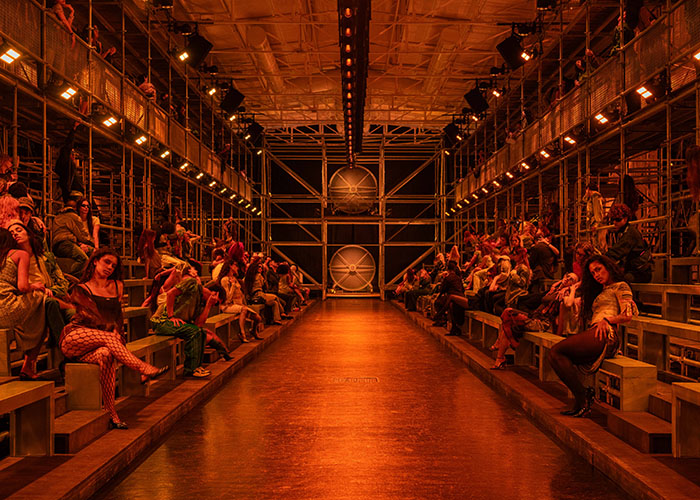
Diesel turned its Spring/Summer 2027 runway show into a full-scale celebration in Milan, presenting Glenn Martens’ final collection for the brand inside a purpose-built club environment charged with movement, tension and surprise.
Rather than treating the show as a conventional farewell, Martens leaned into the qualities that have defined his time at Diesel: experimentation, sensuality, inclusivity and an instinct for disrupting familiar clothes. The result was a collection that looked back at key ideas from his tenure while continuing to push denim, tailoring and everyday wardrobe pieces into unexpected territory.
For Martens, the collection distilled Diesel’s identity into something fluid, playful and democratic. His parting message was simple: the party comes first, and everyone is invited along for one final ride.
A Runway Show Designed as a Happening
The presentation unfolded as both a fashion show and an immersive performance. Marseille-based artist collective (LA)HORDE placed 200 performers throughout the audience, where they interacted with guests and one another as the models moved through the venue.
The interventions shifted between subtle, unsettling and sensual, creating the impression of spontaneous encounters within the crowd. As the show progressed, the tension steadily intensified before reaching a final release, accompanied by a reworking of Donna Summer’s disco classic “Love to Love You Baby.”
That club atmosphere provided a fitting backdrop for a collection built around desire, transformation and the disordered glamour of a night that refuses to end.
Familiar Clothes, Reassembled
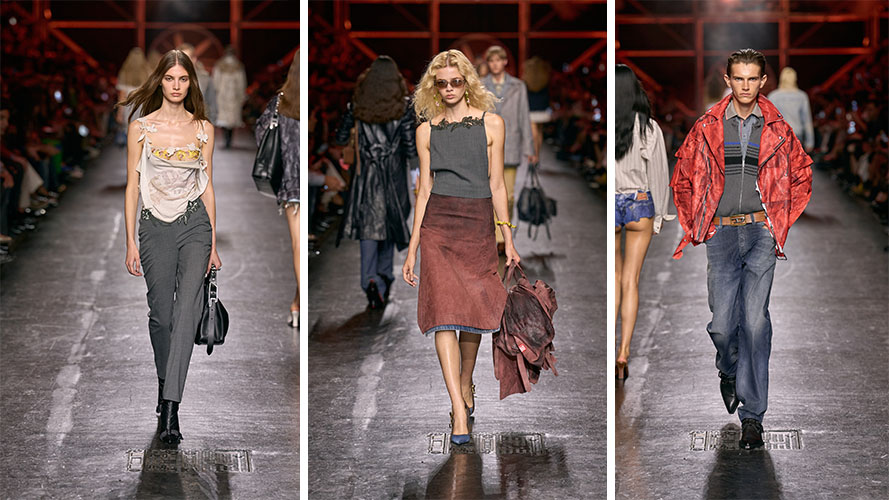
Layering was one of the collection’s defining ideas, but these were not simply garments worn one over another. Diesel fused pieces together to create hybrid looks: a waxed leather jacket met a topstitched blazer, while a ribbed sweater incorporated elements of a tracksuit collar and shirt cuffs.
Orchid-shaped cutaways marked the points where garments appeared to merge. The technique continued across leather and denim pantasocks, cropped knits and sharply tailored separates. Skirts that appeared relatively restrained from the front were dramatically opened at the back, reinforcing the collection’s tension between everyday dressing and after-dark provocation.
Some looks appeared as if they had been hastily twisted, gathered or fastened after an intense night out. T-shirts were reconstructed into bra tops, bandeaux and sundresses, while sheer floral dresses, slip dresses, shirts and tailored pieces were caught up in deliberately imperfect forms.
Trompe-l’Oeil Plays With the Seasons
Martens also continued his fascination with illusion. Lightweight shirts were printed to resemble substantial tweed coats and heavy winter jackets, creating a visual clash between appearance and function. One trompe-l’œil design revisited a raw-edged shearling coat from his first Diesel runway show, giving the collection a direct connection to the beginning of his tenure.
Elsewhere, jersey was printed to look like extremely abbreviated denim shorts. Foil-treated garments were cracked and overprinted with the image of another piece, allowing a denim bomber to masquerade as a baseball jacket or biker jacket.
The visual tricks served a larger purpose. Throughout the collection, familiar fashion codes were questioned: Is a garment still what it appears to be when its material, construction and silhouette tell different stories?
Denim Remains at the Center
For all its experimentation, the collection repeatedly returned to Diesel’s foundation: denim.
Jeans arrived in bootcut shapes with inset panels at the inner ankle, as well as straight-leg versions coated and laser-treated to resemble leather. Topstitching became a prominent design detail, while other jeans featured ankle slits designed to frame stiletto heels. One style incorporated a denim shirt attached at the waist, giving the impression that it had been casually tied around the body.
The final sequence pushed the idea to its most provocative conclusion with ultra-micro denim shorts. Model Ella Snyder wore the last look, bringing the show full circle after having opened Martens’ debut collection for Diesel.
Orchids, Hardware and New Accessories
The orchid emerged as the season’s recurring symbol. Petal-shaped cutaways appeared across striped jacquard knits, polo dresses, slim trousers and tailored skirts, often exposing skin or tracing extremely low waistlines. The flower also appeared as embroidery on lingerie, introduced with boned construction, and as earrings, bracelets, chains and body adornments.
Accessories extended the collection’s mix of utility and irony. The D-ONE bag returned in a range of finishes, textures and colors, with handles that continued into multiple buckled straps along the body. Leather charms transformed ordinary objects into fashion pieces, including a sock-shaped pouch and a newspaper-inspired clutch.
Diesel also introduced the slouchy LOCK-D bag, secured with the Double D motif previously seen in the brand’s jewelry. That same emblem appeared on loafers, slingback sandals, closed-toe mules and kitten-heel clogs. The D-ONE buckle carried over to pumps, heeled mules, stretch boots and clogs, while the men’s offering included Western-influenced heeled boots and denim clogs.
The finishing touches included a miniature version of the metal-bracelet D-RUSH watch and new tonal shades for the transparent-acetate TRAN-D-SPARNT eyewear family.
A Full-Circle Farewell
Spring/Summer 2027 did not read as a quiet retrospective. Instead, Martens used his final Diesel collection to revisit the ideas that shaped his creative direction while keeping the energy firmly in the present.
The references to his earliest work for the house, the return to denim and the casting of Ella Snyder for the closing look gave the show a sense of completion. Yet the clothes themselves remained restless: cut apart, fused together, printed with illusions and designed to challenge where one garment ends and another begins.
It was a fitting final statement from a designer who made disruption feel integral to Diesel’s identity. The party may have marked the end of an era, but it ended at full volume.