

























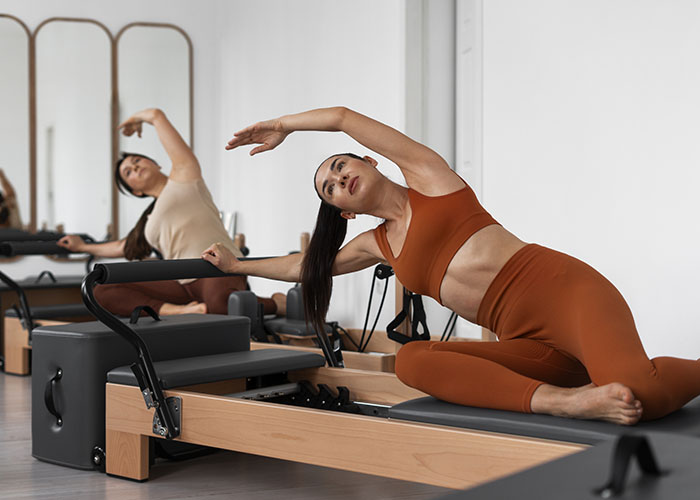
Pilates has become one of the most talked-about workouts in fitness, driven by demand for low-impact movement that delivers functional, lasting results. Industry reports, including data from the Sports and Fitness Industry Association, show Pilates as one of the fastest-growing fitness modalities in recent years, with a 40% increase in popularity, and participation has steadily risen since 2019.
“Pilates works because it strengthens the muscles that support how we move every day,” says Nastasia Liavas, Vice President of Fitness Services at Fitness World. “It builds control, stability, and resilience, which is why people feel better so quickly when they practise it consistently.”
Originally developed more than a century ago to rehabilitate injured soldiers and athletes, Pilates has always been rooted in functional, sustainable strength.
The myth worth busting
Despite its boutique reputation, Pilates results do not require expensive reformer classes. Mat Pilates is the foundation of the method, delivering core strength, flexibility, posture, and stability through controlled movement and breath. While reformers can add resistance and variety, a well-taught mat-based practice produces the same essential benefits in a far more accessible way.
How Fitness World is making Pilates more accessible
Fitness World offers three mat-based Pilates classes designed to deliver results without boutique pricing. While the average boutique Pilates class in BC costs $25 to $45 per session, Fitness World members can access unlimited fitness classes, including three different Pilates class options, for as little as $17.99 bi-weekly. Fitness World’s Pilates classes include:
- Pilates: Focused on precise movement, core engagement, and mindful breathing to improve strength, alignment, and control.
- Pilates Fusion: Incorporates lightweight resistance bands to create a reformer-inspired feel while challenging the core and sculpting the full body.
- Stretch and Sculpt: Blends Pilates, yoga, and strength work to lengthen tight muscles while building tone and mobility.
“Pilates should be something people can return to week after week,” Liavas adds. “Accessibility matters if the goal is long-term health, not just a trend.”
Why Pilates works best with strength training
Pilates activates deep stabilizing muscles, while traditional strength training targets larger muscle groups. Together, they support better performance, fewer injuries, and long-term physical resilience.
Pilates may be having a moment, but its real value lies in consistency, quality instruction, and balance. Fitness World is showing that the benefits of Pilates are not reserved for boutique studios, but are available to anyone ready to move well and train smart.